
7 Stages of Male Pattern Hair Loss
Understanding the Norwood–Hamilton scale
The Norwood–Hamilton scale describes the extent and pattern of male pattern hair loss, also called androgenetic alopecia. It helps document changes but does not predict exactly how quickly your hair will thin or whether you will reach the later stages.
Stage 1: Little or no recession
There is no significant visible recession or patterned hair loss.
Stage 2: Early temple recession
The hairline recedes slightly at the temples, sometimes described as a mature hairline.
Stage 3: Noticeable recession
Recession deepens at the temples, often creating an M-shaped hairline.
The stage 3 vertex variation involves noticeable thinning at the crown, sometimes with less pronounced frontal recession. In the 3A variation, the frontal hairline moves backwards without a separate crown bald spot.
Stage 4: Frontal and crown thinning
Hair loss becomes more extensive at the front and crown. A band of hair across the middle of the scalp still separates these areas.
Stage 5: A narrowing bridge
The frontal and crown areas of hair loss enlarge. The separating band becomes narrower and less dense.
Stage 6: The areas join
The frontal and crown areas merge as the separating band disappears or becomes very sparse. Hair remains around the sides and back.
Stage 7: Extensive hair loss
Only a narrow band of hair remains around the sides and back. Transplant suitability depends on donor hair quality, available grafts and realistic coverage goals.
Your stage is only part of the picture
The scale does not explain every cause of thinning or reveal the condition of your scalp. Shedding, inflammation and other concerns may exist alongside male pattern hair loss.
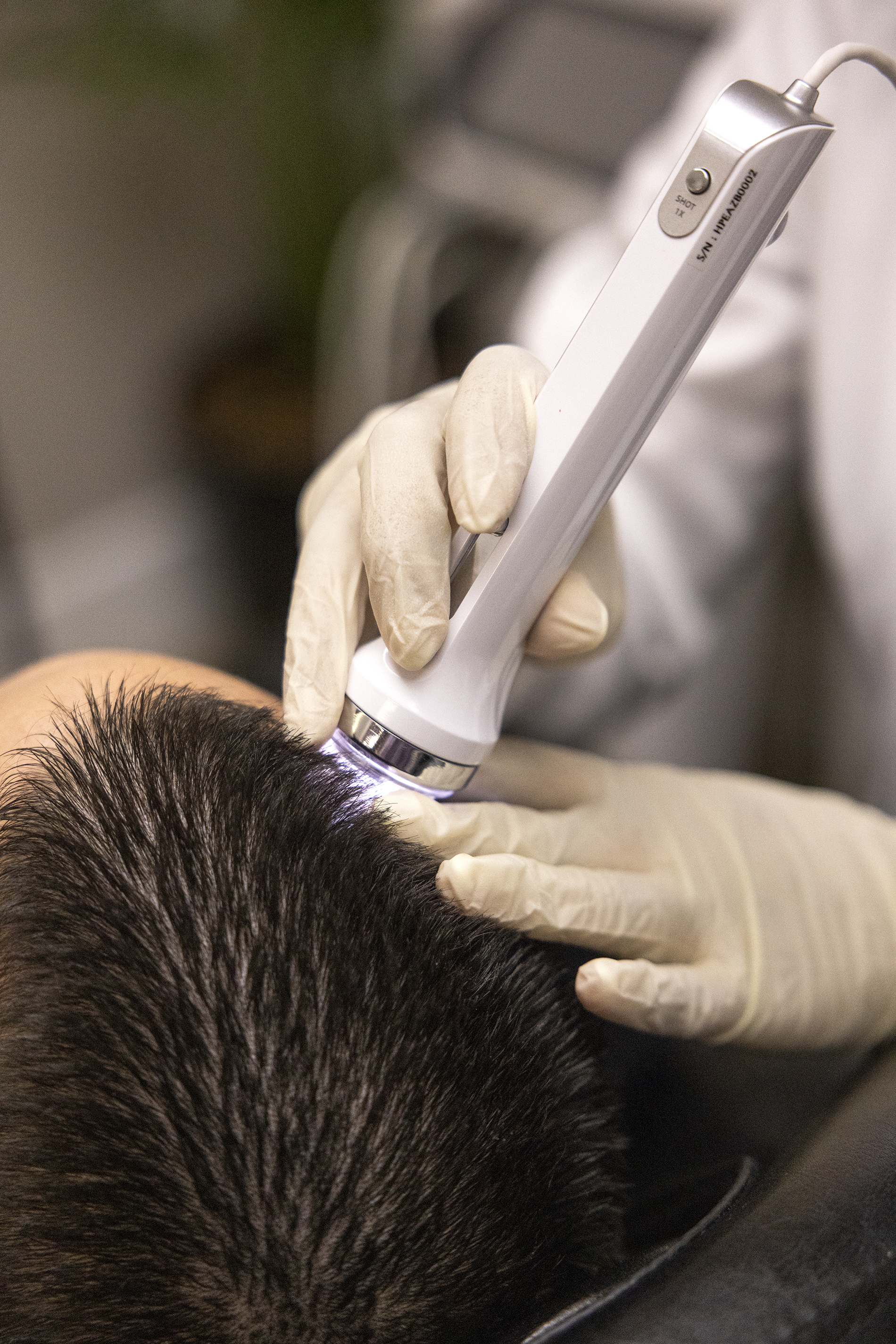
A trichoscopic scalp assessment allows us to examine hair density, calibre and scalp condition, explain what we find and discuss suitable options. You do not need to wait until thinning becomes advanced to seek advice.
Book “Scalp/Hairloss- Clinical Scalp/Hair Analysis” online.


